Loft Conversion Building Regulations in the UK: What Homeowners Need to Know

No matter the type of loft conversion you’re planning or how you intend to use the space, one requirement applies across the board: compliance with building regulations. These standards are in place to ensure that any new living area is structurally sound, fire-safe and energy efficient.
While meeting building regulations is a legal requirement, understanding what they involve — and how they influence your design — can feel overwhelming. Below, we break down the key regulations that apply to loft conversions and explain how approval is typically secured.
Why building regulations apply to loft conversions
Building regulations exist to protect the health, safety and wellbeing of occupants. For loft conversions, approval is required regardless of the size or complexity of the project.
Regulations typically assess:
- Structural strength of the new floor
- Stability of the roof and supporting elements
- Fire safety measures and escape routes
- Staircase design and access safety
- Sound insulation between floors
- Thermal efficiency and ventilation
Because these areas overlap multiple disciplines, projects usually involve input from technical designers, structural engineers and building control officers. Final approval is issued either by the local authority or a privately appointed approved inspector.
Structural requirements for loft floors
In most traditional lofts, existing ceiling joists are not designed to support habitable loads and must be upgraded or replaced.
Typical joist spans include:
- 47 × 145mm joists: spans up to 2.89m
- 47 × 170mm joists: spans up to 3.38m
- 47 × 195mm joists at 400mm centres: spans up to 3.87m
- 72 × 145mm joists: spans up to 3.33m
- 72 × 170mm joists: spans up to 3.89m
- 72 × 195mm joists: spans up to 4.44m
These figures are indicative only — a structural engineer will calculate exact requirements based on your property and layout.
In addition, at least 100mm of insulation is typically required between floor joists to reduce sound transfer.
Fire safety standards
Fire protection is one of the most closely scrutinised aspects of a loft conversion. Key requirements include:
- Fire doors
Existing doors along the escape route may need upgrading to fire-resistant doors capable of resisting fire for 20–30 minutes. - Smoke detection
Interlinked smoke alarms must be installed within the new loft space and connected to the existing system. - Fire-resistant construction
Walls, ceilings and structural elements must limit fire spread long enough to allow safe escape. - Sprinkler systems
Not mandatory, but permitted if water pressure and system design allow.
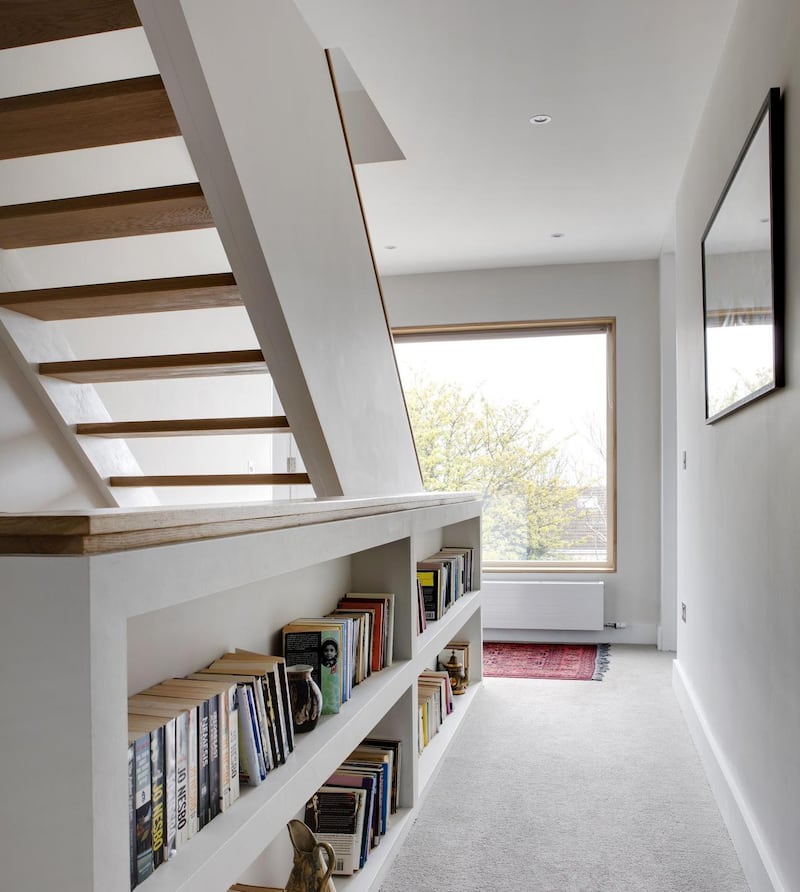
Staircase compliance
Access stairs must meet strict dimensional and safety standards.
Width and number of steps
- No absolute minimum width, but 600–750mm is commonly accepted for loft stairs
- Maximum of 16 risers, though most designs use fewer
Rise and going
- Rise: 150–220mm
- Going: 223–320mm
All steps must be uniform
Headroom
- Minimum head height of 2,000mm throughout the staircase
Thermal insulation requirements
Up to a quarter of a home’s heat loss can occur through the roof, making insulation a key consideration.
- Where no insulation exists, roofs must achieve a U-value of 0.16 W/m²K (often around 250mm of mineral wool)
- Where insulation is already present, building control will typically expect an improved U-value of 0.35 W/m²K or better
Other regulated elements to consider
Beyond structure and fire safety, building regulations also apply to:
- Windows and doors — thermal performance and escape provisions
- Drainage and plumbing — compliance with Approved Document H
- Electrical installations — carried out by certified installers
- Walls and ceilings — insulation and minimum head height (usually 2.2m in usable areas)
Who is involved in the approval process?
Most loft conversions require coordination between several professionals, including:
- Technical designers to prepare detailed construction drawings
- Structural engineers to confirm load paths and calculations
- Building control officers or approved inspectors to review and inspect work on site
Approved inspectors are registered through the Construction Industry Council and can often provide faster approvals than local authorities.

Submitting a building regulations application
Applications are made either through:
- A Full Plans submission (most common)
- A Building Notice (for simpler works)
Full Plans applications typically take up to 8 weeks for approval. Approved inspectors may reduce this timeframe significantly.
Do loft conversions require planning permission?
Not always. Many loft conversions fall under Permitted Development, provided strict size and design limits are met. However, a Lawful Development Certificate is still recommended as formal proof of compliance.
Permitted Development is not faster — but it is less subjective than full planning permission.
Party Wall considerations
If your loft conversion affects a shared wall, floor or boundary, the Party Wall etc. Act 1996 applies. You must notify affected neighbours in writing before works begin.
If consent is not given within 14 days, a formal party wall agreement must be prepared by a surveyor to protect both properties during construction.
.png)

.jpeg)


With over 500+ projects completed nationwide.



